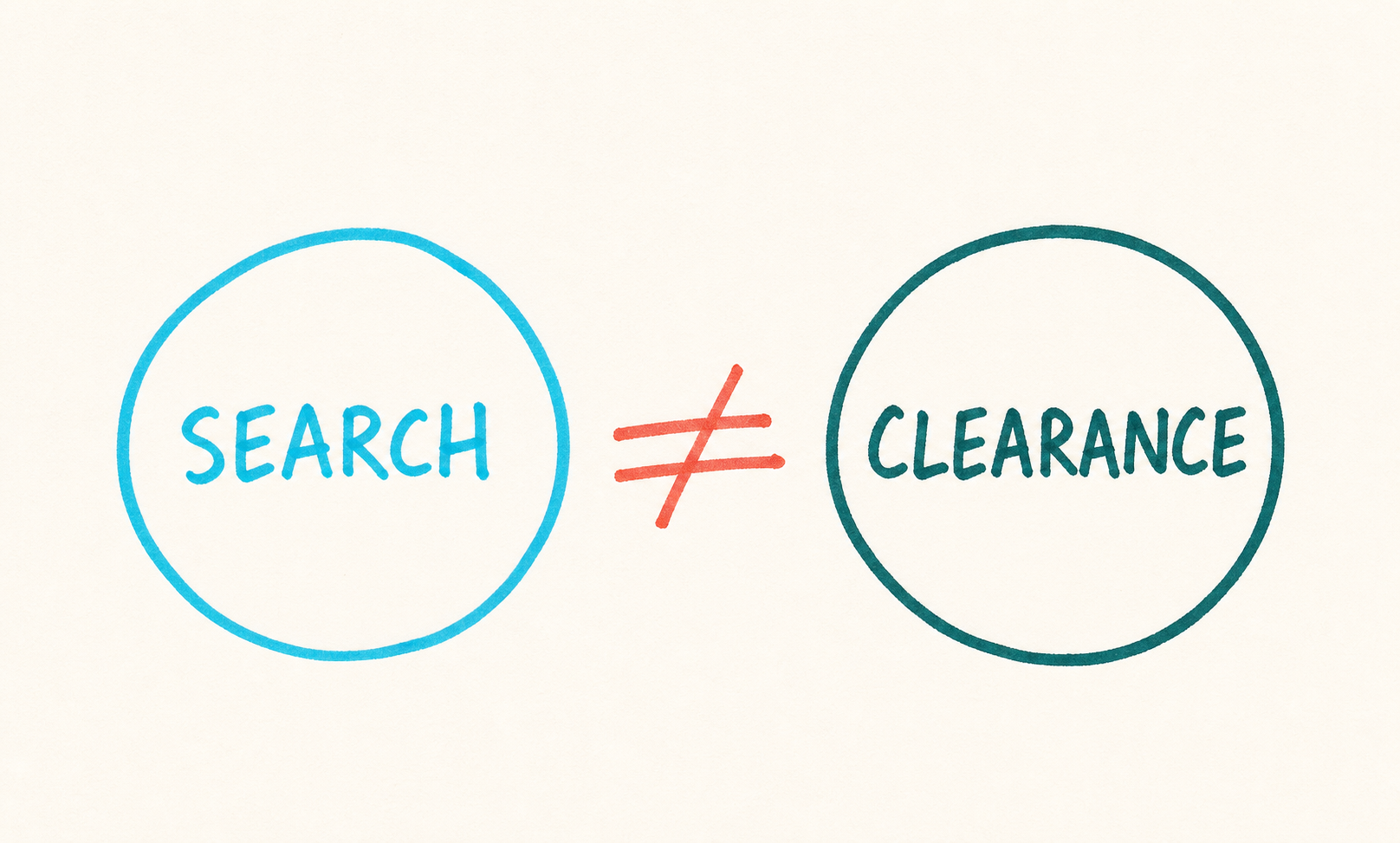
A trademark search helps. It is not legal clearance.
Use official databases to catch obvious risks, then understand what those searches cannot decide.
How should a POD beginner check a phrase before designing?
Quick answer
Use official databases to catch obvious risks, then understand what those searches cannot decide.
Reviewed Jul 25, 2026
Educational screening, not legal clearance
A database search can catch obvious risks, but it cannot decide copyright, confusing similarity, publicity rights, common-law use, or every jurisdiction. Get qualified advice when the risk or investment matters.
Search the phrase, then its near-neighbours
A search can help you spot obvious conflicts. For a United States-focused launch, start with the USPTO's official trademark search. Search the exact phrase, close spellings, singular and plural forms, related wording, and the goods or services that match your product.
If you plan to sell elsewhere, check the relevant national or regional register too. A clean result in one country does not clear a launch everywhere.
Treat the result as a lead, not a verdict
A database search does not decide copyright, publicity rights, trade dress, common-law use, every jurisdiction, or whether two marks create a likelihood of confusion. 'No exact match' is not the same as legally safe.
- 1
Record what you searched
Save the market, date, database, terms, owners, status, and links. A screenshot or note is more useful than trying to remember the result later.
- 2
Keep the rights paperwork
If someone else made the artwork, keep the licence or commissioning agreement with the project files. A trademark search cannot replace permission for the artwork itself.
- 3
Pause when the stakes rise
If the phrase will carry a brand, paid traffic, or a serious inventory commitment, take the search to a qualified lawyer before you build around it.
- Avoid third-party brands, logos, characters, teams, lyrics, and celebrity identities
- Search the market where you plan to sell
- Keep the search notes and rights paperwork
- Get qualified legal advice when the brand or investment matters
Read marketplace rules separately
Marketplace eligibility and intellectual-property risk are different questions. Etsy, for example, requires qualifying seller creativity and production-partner disclosure under its current policies. Read those rules separately from the trademark result.
Sources used for this guide
Check the linked source before acting on time-sensitive fees, policies, availability, or production claims.